Is A Copyright Registration Really That Easy To Obtain?
Artist: Robert Bénard
Filing for a US copyright (CR) registration can be a wonderful secret weapon of any business. A CR registration provides federal IP protection that can be leveraged in a really big way. For example social media platforms like Meta have policy in place to assist in enforcing CR registrations. This can be pretty handy when as a business owner, you’re faced with another party copying your registered content. Having Meta ‘take-down’ your CR violators can be pretty satisfying.
Enforcing US CR registrations can also be enforced by YOU the small business owner at the Copyright Claims Board. This US Copyright Office (USCO) forum is fairly new at the time of this writing, but the forum is designed to provide an ‘uncomplicated’ way of allowing registered copyright owners to enforce their rights. Claimants with eligible copyright infringement, noninfringement, or misrepresentation claims that request relief of $30,000 or less can assert and their rights through this forum.
The owner of a copyright has exclusive rights to do and to authorize any of the following:
Reproduce the copyrighted work 👈🏿
Prepare derivative works 👈🏿
Distribute the work to the public 👈🏿
Perform the work 👈🏿
Display the work 👈🏿
And of course CR registrant owners can enforce their rights in federal court for copyright infringement. That means you can enforce your copyright to enjoin (making someone do/or not do something), for damages (money), and for costs (attorney’s fees and court costs to enforce your rights).
The USCO registration process has a reputation for being user friendly. The forms are straight forward, the cost of registration is relatively modest compared to the USPTO trademark and patent process, and a copyright registration can be obtained relatively quickly. But, the ease, convenience, and enforceability of a valid USCO registration turns on filing the application correctly, and choosing the correct type of work. Otherwise, you may FAFO you have nothing to enforce.
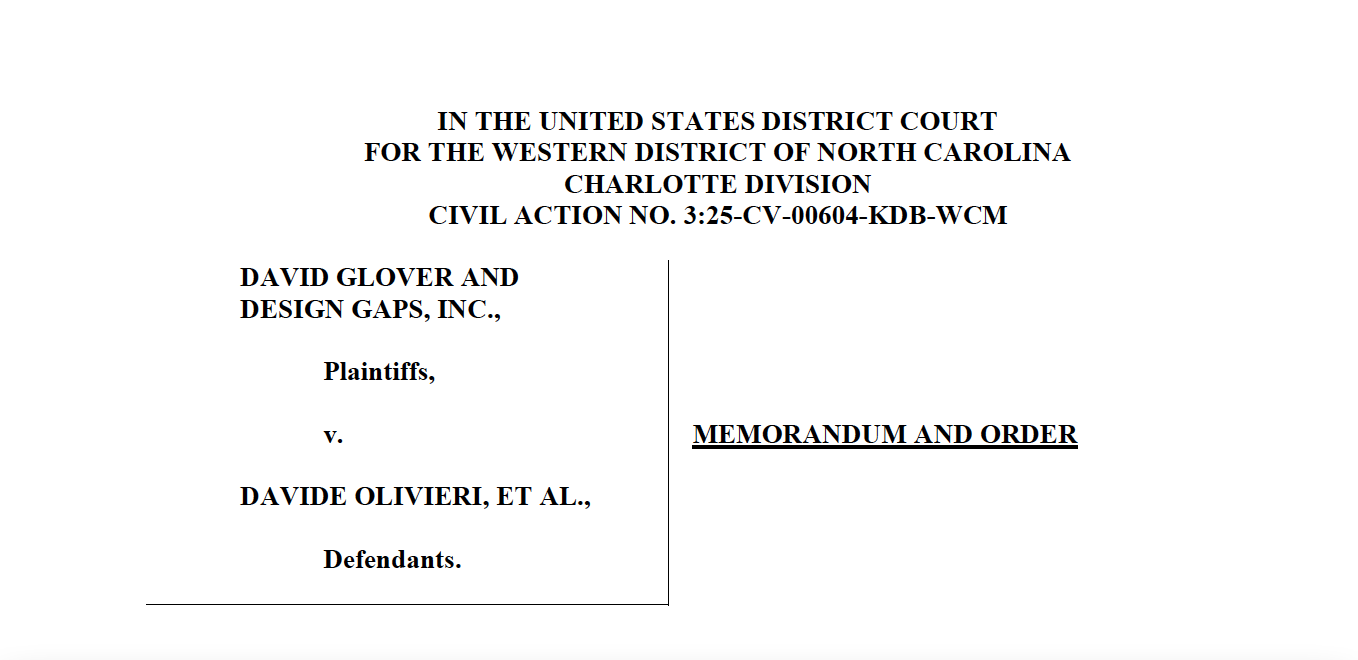
In the case of David Glover, et al vs Davide Olivieri et al, Mr. Glover was a cabinet designer and he worked with Mr. Olivieri who was a builder to have Mr. Glover’s cabinetry designs installed in a home. After a period of time, Mr. Glover began to wonder about whether the project was proceeding as there was a gap in communication. According to court documents, Mr. Olivieri indicated the project would not proceed, but Mr. Glover learned otherwise, and believed his cabinetry designs were being reproduced without his consent or compensation. Mr. Glover filed for a copyright registration on the design of the cabinetry and obtained a registration. When he filed at the USCO, he chose to file his cabinetry as an ‘architectural work.’ The types of works one can choose include the following: literary works, musical works, dramatic works, pantomimes/choreography, visual/sculptural arts, audiovisual works, sound recordings, and architectural works. Each type of work carries unique requirements for deposits and the like. Once selected, the type of work selection on the USCO application cannot be changed. If the type of work selected is incorrect, an applicant will need to begin a new application.
Unfortunately for Mr. Glover, the court found he selected the wrong work when we completed the application process, and consequently, the court did not enforce the CR and dismissed the case.
Based on my review of the complaint and CR registration, Mr. Glover may not have hired counsel to file the application, and may have filed himself. So he unfortunately FAFO the hard way that you must choose correctly in the application process, or pay the price. The filing process is not merely administrative, but rather can have substantive implications on the enforceability of the IP right.
Last Word
As a business owner or IP rights holder, when you file for IP projections on your own just beware, you must read the fine print. Protecting IP can highly nuanced, and even something that appears so insignificant in the application process can have a huge impact.
Get More Information
Angela Grayson, CIPP/US, CLP is an author, speaker, and lawyer. She is the Principal and Founder of Precipice IP, PLLC. Angela is a patent, trademark, copyright, and technology law attorney with over 20 years of experience helping science and technology companies protect products, brands, designs, and data from idea to launch.
👉🏿 Sign up to join our community for more information about ways to manage your company’s intellectual property. PRECIPICE provides intellectual property and technology law services, such as patents, trademarks, copyrights, privacy, and business expertise to science and technology startups.
Read more about it …